Pages

October 12, 2010

On The Road Review: Honda CR-Z Hybrid

Honda and Toyota have been building hybrid-powered automobiles for retail consumption since 1996. The acknowledged leaders in this engineering segment — combining small internal combustion engines with electric motors and sophisticated battery packs — each maker has pursued different avenues with varying degrees of success.
Honda’s first hybrid was the diminutive Insight two-seater, the master at maximum fuel efficiency, but sorely lacking in flexibility and family practicality. Toyota countered with the oddly styled (as if the Insight was conventional) Prius, a more utilitarian four-door design with more packaging space and room for up to five. While the Insight earned its wings with big highway fuel economy, the Prius attracted a whole lot more buyers and vaulted Toyota into the hybrid forefront.
Honda then countered with the hybrid Civic, a nice compact package that really differed little from the run-of-the-mill Civic. A powerful Accord with a V-6/hybrid powertrain debuted next — easily the fastest hybrid we’ve seen commercially, but it didn’t get the marketing push it needed. Lacking the distinctive body of the Prius, both the Civic and Accord hybrids languished in showrooms.
Sensing that individualist styling is an essential component of the hybrid phenomenon, Honda is returning to the future with another small hybrid offering based on a previous model that earned its renown as a sporty coupe. In the 1980s, Honda sold a small car called the CRX. In Si trim, this was a sporty small hatchback that was thrifty as well as a fetching handler that did very well for a front drive car. A passionate following resulted.
The new compact hatch is called the CR-Z, a take on the previous model’s sporty name — and its zippy appearance — with the addition of electrical backup power.
With modest sales expectations — only 15,000 units a year — Honda’s sport-hybrid concept almost seems like a contradiction. Are sporty car buyers going to embrace a meager 122 hp? Are fuel miserly drivers going to be attracted to a cute compact that ‘only’ gets 39-mpg highway?
The key answer to both questions might lie somewhere in the middle — like in the middle of the car, where a polished gearshift lever protrudes from the center console. The CR-Z is the first hybrid car sold here that sports a real, honest to goodness six-speed manual gearbox; a slick close ratio transmission that sporty car drivers will really like to utilize and hyper-milers know maximizes fuel economy.
Sure, there is a CVT automatic transmission too, the boring choice for most hybrid manufacturers, bless their picked little engineering heads. Given my druthers, the six-speed transmission makes the CR-Z not only entertaining, but more sensible as an economy car, too.
Like other Honda hybrids, the CR-Z has three selectable modes, ECO, Sport and Normal, each of which changes the car’s operating performance to suit the driver’s choice. Sport mode offers higher revs, quicker steering and delayed nanny system intervention, while ECO mode helps the CR-Z more quickly enter its most fuel-efficient operation with idle-stop technology and less power on tap.
Most of the CR-Z’s electric power comes from the regenerative braking system, while a large bank of D-cell sized nickel-metal hydride cells hide under the rear cargo compartment ready to render power assistance. Like the original CRX, as well as the Insight, the CR-Z is strictly a two-seater with a modest cargo area under the rear hatch, plus added cargo space directly behind the front seats. By appearance, it seems that Honda could have added two jump-seats here, something suitable for small riders ala Porsche or Jaguar, just by adding a couple of inches. But Honda wanted to keep the car small. There is no denying that they reached that goal, as the CR-Z is barely 160 inches long while riding on a small 95.9-inch wheelbase. Flip down the center cargo divider and there is a relatively long, flat load floor under the rear hatch.
Ah yes, the hatch. For all intents and purposes, the CR-Z has a horizontal glass roof panel that might be considered a sunroof on most cars. But this one comes with an elongated wiper and you actually look through it to see objects behind you — and not very well either. As with the hideous configuration on the Prius and Honda’s current four-door Insight, there is a narrow lower window slot just below the large crossbar in the rear hatch — right where you want to be looking. This car cries out for a rear-view camera.
Operators will find the CR-Z’s cockpit quite a blend of buttons and switches closely integrated onto the steering wheel hub or on dash extensions surrounding the three-spoke wheel. Blue-illuminated dials and gauges lend an electronic air of sophistication, but some of the information seems superfluous.
Clutch action and shifting are swift, light and efficient in a way that is synonymous with other sporty Hondas of old. Steering feel is surprisingly engaging for an electronic system, earning the CR-Z kudos for mastering an art that often seems lost.
Unfortunately, the CR-Z also reflects Honda’s historical lack of road noise suppression. The interior is plain loud at highway speeds, making stereo output muffled and conversation strained. The Honda seems louder than the recent Jeep, which doesn’t even have a roof liner. The optional navigation system proved easy to use, but satellite radio is not included.
Visibility to the rear and the sides is also stunted in the low-riding CR-Z. This will not bother most buyers, as the car’s zoomy exterior styling and modern interior layout will win points.
I think the younger generations among us will be the primary buyers of the CR-Z. It looks different from other small cars, plus it boasts enough fuel efficiency and technology to attract drivers who admire the latest electronic gadgets. With the stick shift, the CR-Z is also fun to drive, not something you can say about the other hybrid cars.
Honda wants all of its products to be more fuel-efficient and the CR-Z reaches that goal. For drivers who want a little edginess with their miserly driving, then maybe the CR-Z can fill a profitable niche.-fenceviewer.com

October 11, 2010

Mercedes tarik balik C-Class, E-Class


Mercedes Benz C-Class.


WASHINGTON - Pengeluar kereta Mercedes-Benz mengumumkan penarikan semula kira-kira 85,000 unit kenderaan model C-Class 2010 dan model E-Class Coupe serta Cabriolet 2011 kerana masalah stereng.
Menurut agensi berita AP semalam, sistem stereng kenderaan itu mungkin gagal berfungsi sepenuhnya ekoran kebocoran cecair stereng.
Laporan mengenai masalah itu dikemukakan kepada Pentadbiran Keselamatan Trafik Lebuh Raya Kebangsaan Amerika Syarikat (NHTSA).
Menurut pengeluar kereta itu, satu penyambungan pada saluran stereng kuasa didapati tidak berfungsi dengan sempurna sekali gus mengakibatkan cecair untuk stereng mengalami kebocoran.
"Pemilik-pemilik mungkin tidak mempunyai kawalan yang mencukupi ke atas kereta itu ketika berada dalam keadaan seperti mahu meletakkan kenderaan di tempat letak kereta yang memerlukan kuasa maksimum stereng," kata pengeluar kereta tersebut dalam satu laporan kepada NHTSA yang didedahkan oleh LA News Monitor.com.
Syarikat pengeluar kereta dari Jerman itu mengetahui masalah itu berdasarkan aduan daripada beberapa pengguna kenderaan berkenaan.-kosmo.

Spyshots : 2012 Honda Civic, completely naked of all camouflage!

2012 Honda Civic : Dubai Testing Spyshot

According to CAR Middle East for the set of the next generation Civic sedan, completely naked of the elastic-film camouflage.


The 2 civic prototypes have been hot weather test in Dabai, UAE. It's very similar in dimensions to the existing model, the windshiled, windows and side-mirrors look to be unchanged.

The new front fascia, the character line from the headlight be speared off and extended the arrow-shaped rear cluster. The rear circular lamps be replaced with new shape tail-light. The exterior design may be inspired with the Honda City's Asian market.


The interior, 2 level dashboard to be retained with three-spoke steering wheel. The center console equipped with 2 DIN touch screen audio/navigation system on the climate controller.

The source said, the prototypes powered by 1.5-litre engine, similars with Fit or City powertrain for fuel economy ? Wait and see it next year.-carmiddleeast.com

October 9, 2010

Gambar Proton Inspira di Genting Highlands

Bagi peminat Mitsubishi Lancer, anda tidak perlu membuang duit lebih RM100 ribu hanya untuk membeli kereta ini. Proton akan menjualnya pada harga lebih murah iaitu RM60k hingga RM70k bagi 1.8cc & RM80k hingga RM90k bagi 2.0cc. Setakat ini hanya ada dua warna sahaja dikeluarkan iaitu putih & merah.

Antara aksesori yang terdapat pada versi 2.0cc ialah kusyen kulit, paddle shift, auto cruise & spoiler. Proton Inspira yang dipasang di Shah Alam khabarnya akan dilancarkan pada 16.10.2010 & akan mula dijual pada hujung tahun 2010. Bagi saya tiada apa yang menarik pada Proton Inspira ini kerana ia bukanlah produk asli Proton sama seperti kereta Kia yang ditukar logonya menjadi Naza.

PPI RAZOR Audi R8 GTR-10 Limited Edition

PPI RAZOR Audi R8 GTR-10 Limited Edition
The only exclusive Audi-tuner from Germany, PPI Automotive Design GmbH, breaks through the Audi-tuning arena yet again, and presents their new limited production Supercar, the PPI RAZOR GTR-10. The Audi specialist turned its focus on optimising the power-to-weight ratio of the Audi R8 while simultaneously strengthening the motor, increasing performance, improving handling dynamics, and managing to reduce the weight of the Audi R8. The end result is a culmination of knowledge from the past year in research and development to create a truly inspired production car; the RAZOR GTR-10. This vehicle will be available to only 10 select individuals.

Performance

Following the introduction of the PPI RAZOR GTR supercharged V8; PPI Automotive Design GmbH has increased their repertoire by refining the Audi R8 V10 model. PPI Automotive Design utilized all its magic to optimize the aerodynamics as well as performance of the series vehicle.

PPI RAZOR Audi R8 GTR-10 Limited Edition

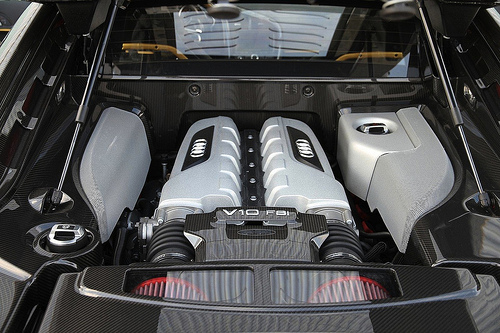
The essential part of the motor alteration is the incorporation of race-proven parts. The air intake system over the rear engine cover is not only a lightweight component but also serves dual duty as a channel for the ram-charged sport air filter system. A lightweight high performance exhaust system made of stainless steel has been designed and added specifically to work in conjunction with the V10. This is tipped off with Ceramic-Coated oval tips. These components are precisely adjusted to each other with the help of a new ignition map for motor electronics. The result is pure engine refinement of the highest calibre.

PPI RAZOR Audi R8 GTR-10 Limited Edition

The performance numbers:

The result, after this extensive modification, is a normally aspirated V10 engine with over 601 hp (448 kW).

at 7,400 rpm, and a maximum torque of 565 Nm at 6,400 rpm at its disposal. Couple the power increase with a weight decrease of 250 kg (depending on options) over its serial counterpart (serial curb weight V10 R-tronic: 1,625 kg). The end result is the ability to achieve speeds from 0 to 100 km/h in a mere 3.2 seconds (with modified R-tronic Gearbox) and a maximum top speed of 335 km/h. This insures the proper performance to easily meet the demands of its motorsports and enthusiast clientele.

PPI RAZOR Audi R8 GTR-10 Limited Edition

Aerodynamics

In addition to the excellent driving performance, this PPI Supercar also has a striking widebody appearance with elaborate, wind tunnel tested aerodynamics. Special attention was paid to the reduction of the vehicle’s weight, which was achieved by PPI’s extensive use of the high-strength formula 1 and aerospace-proven Carbon Fibre technology. All parts are made of this high-tech material, reducing weight and adding strength in the process.

The RAZOR GTR-10 front bumper replaces the serial bumper and the new design in conjunction with a specially engineered front diffuser reduces lifting forces at the front axle. Larger air inlets in connection with a new incorporated LED day-running unit present the two-seater with an even more athletic and aggressive face. More importantly, these air inlets feed the radiators with additional fresh air and channels through the new front hood to provide optimal cooling to the brake system. PPI sideskirts highlight the sporty profile of the RAZOR GTR-10 and also diffuses the airflow around the sides of the car for improved aerodynamic stability. The inlets of the sideskirts further aid much needed cooling to the engine oil coolers and rear brake system.

PPI RAZOR Audi R8 GTR-10 Limited Edition

The roof pillars and doors, like the rest of the supercar, are draped in carbon fibre.

In order to perfectly balance out the down-force behaviour of the front-axle with the rear axle, PPI equips the RAZOR GTR-10 with a special hollow, Carbon Fibre rear wing with an adjustable Gurney-flap. The motor cover is made of carbon fibre and incorporates glass made of the light high-tech polycarbonate material Makrolon®. The engine lid also has specially designed Carbon Fibre ram-charged air inlets that replace the heavy OE/OEM Engine cover and further aids in cooling the engine as well as feeding ram-charged air to the intake system, ensuring the consistent performance of the RAZOR GTR-10. Aiding in the engine cooling, are the newly designed side blades, rear fenders and rear bumper that all allow for additional motor bay and exhaust cooling that, in conjunction with the Carbon Fibre rear diffuser, optimises the airflow over and through the rear portion of this sharp performance car.

Handling

A new widebody skin allows the PPI RAZOR GTR-10 the proper structure to accommodate all the performance enhancements, including wider wheels and tires. Not to mention enhancement to the overall appearance of the car. The RAZOR GTR-10 utilizes specially designed lightweight MAG11 Forged Aluminium PPI wheels. At the front, 9Jx19 MAG11 wheels weighing 10.0 kg with 245/35 ZR 19 Michelin Pilot Sport 2 tyres are fitted and an impressive 12.0J x 20 MAG11 wheels weighing 10.9 kg with 325/25 ZR 20 Michelin Pilot Sport 2 tyres are used at the rear. This wheel and tyre-combination proves to be the optimal balance between comfort and control while maintaining proper road feedback for the driver.

PPI has also developed a special high-performance braking system available for the RAZOR GTR-10 that can be identified by its metallic orange-coloured brake callipers. The optimal deceleration and perfect pedal pressure control is now achieved by enlarged 6-piston callipers in connection with extra-large discs measuring 380 x 36 millimetres at the front and 356 x 32 mm discs at the rear axle providing greater pad surface contact area and heat dissipation. Alternatively, the vehicle can be equipped with Audi’s Carbon Ceramic Brake System with PPI-specified higher friction brake pads.

Nothing has been left untouched, as is evidenced by the new coil over kit developed in conjunction with technology partner KW Automotive GmbH. This system has been specially adjusted to the needs of the RAZOR GTR-10. And comes equipped with a Hydraulic Lift System for the front axle, which can increase ground clearance by up to 45 millimetres if needed and therefore enables the driver to enter underground car parks or drive over speed bumps. This system in combination with PPI’s Springs, Camber Kit and Tie-rod kit ensure that the RAZOR GTR-10 stays sure-footed and balanced in any situation, whether on the street or race track.

PPI RAZOR Audi R8 GTR-10 Limited Edition

Interior “Performance”

PPI completely redesigns the interior and turns the R8-interior into a “members-only” lounge with a motorsports flair. The serial interior is replaced by highest quality Onyx Nubuck-leather with Metallic-coloured accents and highlights per clients request. Additionally, PPI equips the limited edition RAZOR GTR-10 with extensive Carbon Fibre throughout the cockpit; hand-brake lever, door sill protectors, driver and radio console surround, door trims, center console inserts, and kneepad trims. The ultra-light folding sport seats are also made of Carbon Fibre and bear the PPI “Sport Identity” style, which is present in the headliner, the steering wheel, shift knob, door panels and center console. The technical highlight of the interior is the ergonomically re-designed PPI sport steering wheel with steering wheel-mounted Carbon Fibre Shift Paddles (R-tronic only).

Highlighting the exclusivity of this limited series production is the RAZOR GTR-10 badging, threshold plates, and an aluminium production plaque framed by Carbon Fibre.

The new PPI RAZOR GTR-10 Supercar…. BOLD Design, SHARP performance, and EXCLUSIVE production, developed and presented by PPI Automotive Design GmbH, the only tuners for Audi automobiles with a true focus on “Engineering in Style.-autogeeze.com

Recall to cost Proton RM5mil

The recall of 15,911 of Proton Holdings Bhd’s Gen.2 and Satria Neo models made between 2004 and 2008 due to a clock spring malfunction is likely to cost the company an estimated RM5mil, according to analysts.
Based on reports, the clock spring connects switches and airbags to the radio, horn and cruise control.
OSK Research in its report yesterday said assuming that all the cars were affected, the repairs, which would involve replacement of the driver’s side airbags, would cost RM300 to RM400 per car.
“Assuming a worse-case scenario that would affect all 15,911 cars relating to deployment of the driver’s side airbags, this could see the total costs of the recall hovering between RM4mil and RM5mil, which is 1.4% of our financial year 2011 (net profit) forecast.”
MIDF Research in its report said it expected minimal impact to earnings as the number of cars affected was small and the parts affected not too costly.
“The recall affects 15,911 cars out of a total of 660,000 produced and sold by Proton over the four-year period. A quick check revealed that the replacement cost is relatively inexpensive (around RM300) and the work can be done fairly quickly in about one hour.
“The total cost for Proton is estimated at RM4.8mil,” it said.
OSK said the impact was likely to be minimal, given that the recall affected the company’s non-core models.
“On a positive note, however, the recall so far is limited to Proton’s non-core models although we do not rule out that this could affect its key models, such as the Saga, Exora and Persona, though we think chances of this would be quite minimal as Proton has stepped up its efforts to improve its quality given its improved rating,” it said.
OSK said it was making no changes to its forecast currently pending more clarity and guidance from Proton.
An analyst said the real impact would be on Proton’s brand image.
“Proton has always had issues over the quality of its vehicles, though the company has been doing a good job in recent years to help rectify this,” he said.
“News of its cars having defects will only refresh the memory of potential car buyers on the quality issue and this could steer them towards other makes that have a more sound track record. The uphill climb of assuring buyers about its quality just got harder.”
OSK also said the stock could face temporary negative reaction as the improved quality perception on Proton might be reassessed by potential buyers and also investors.
Proton’s shares closed down 4 sen to RM4.87 at 5pm yesterday on news of the recall.
HwangDBS Vickers Research in its report said there could be a knee-jerk reaction to the recall.
“This should drive Proton to be more diligent in sourcing its parts and improve the quality of the vehicle it produces,” it said.
Given that under 16,000 vehicles are affected against an annual sales volume of about 160,000 units, HwangDBS Vickers expects the impact on earnings on Proton’s financial year ending March 31, 2011 (FY11) to be minimal.
For FY10, Proton posted a net profit of RM239.09mil from a net loss of RM301.81mil a year earlier. Revenue increased to RM8.23bil from RM6.49bil previously.
Total sales volume increased 11% to 174,481 units from 156,845 in FY09.
AmResearch in its report said it did not think Proton would bear the full recall cost as part of the fault lied with the suppliers.
“While the recall may have a certain amount of impact on Proton’s sales volume, we note that Satria Neo and Gen.2 only account for 4% of Proton’s average monthly sales volume in 2010,” it said.
“Additionally, the quantum of recall is much smaller compared with the 34,000 units of the Savvy model that were recalled back in 2008 for wheel bearing problems.”
OSK also concurred that the recall of the Savvy in 2008 had a minimal impact on the company.
“Despite the concerns, earnings were not affected as Proton’s sales remained resilient given that the Savvy is a not a key contributor to total sales due to its small volume.
“Given the earnings potential from the newly-released Saga back then (January 2008) amid the negative news on the Savvy recall, Proton’s share price did not take any hit at all as the stock price ended in positive territory,” it said.
In a statement on Thursday, Proton group managing director Datuk Syed Zainal Abidin Syed Mohamed Tahir said although the number of vehicles affected was small, the safety of its customers was paramount.
The cost of replacing the clock spring at its authorised service centres would be borne by the company, Proton said in the statement , adding that it would be sending letters to affected customers alerting them to the defect.-thestar.

October 8, 2010

2011 VW Eos Gets A Facelift


2011 VW Eos Gets A Facelift 2011 VW EOS facelift 1
VW unveiled the new version of Eos featuring a rather deep facelift for 2011, and announced its debut at the forthcoming Los Angeles Motor Show. The Eos has always been a great car offering good value for money, mainly thanks to its folding metal roof. And while the new model maintains this feature, it becomes better in terms of design and equipments.
Set for market launch in early 2011, the new Eos comes with a new design which is more elegant than the previous gen, but more and more similar to other Volkswagen models of today. It’s a fine design all around. There’s new grille, new headlights and tailights, LED daytime running lights, and modified bumpers front and rear.
Some of the new toys you get with the new Eos include multi-functional color display on the center console, Keyless entry and start, Park Assist and …
As for the engines, the lineup includes two TFSI units with 122 PS (90 kW) and 210 PS (155 kW), and a 2.0 liter TDI with regenerative braking system and Start Stop technology, capable of 140 PS (103 kW) averaging 4.8 liters per 100 km.-motorward.com
2011 VW Eos Gets A Facelift 2011 VW EOS facelift 2
2011 VW Eos Gets A Facelift 2011 VW EOS facelift 3
2011 VW Eos Gets A Facelift 2011 VW EOS facelift 4
2011 VW Eos Gets A Facelift 2011 VW EOS facelift 5
2011 VW Eos Gets A Facelift 2011 VW EOS facelift 6

October 7, 2010

smart USA looking to bring Nissan five-door to U.S. market

A rendering of the planned new five-door car to be distributed by smart USA

smart USA announced today that it will be collaborating with Nissan on a new five-door car. According to a Memorandum of Understanding between the two companies, smart USA would obtain the rights to procure and distribute a five-door, gasoline powered, B-segment vehicle from Nissan for sale through the smart USA retail dealership network.
“The new vehicle will expand smart USA’s product lineup, offering five-seat capacity while maintaining the core principles of efficiency and conservation,” said smart USA president Jill Lajdziak.
smart USA, a wholly-owned subsidiary of Penske Automotive Group, has been the distributor for Daimler's smart brand in the U.S. since 2006.
There's not much else in the way of detail to report on. The MOU is non-binding and only these two sketches of the car have been released.
“We are proud to be a partner with both Daimler and Nissan, two companies focused on bringing high-quality, fuel efficient products to the U.S. market,” said Penske Automotive Group Chairman Roger Penske.
on-European readers may be surprised to learn that this will not be the first five-door smart car. Starting in April 2004, Daimler partnered with Mitsubishi to produce the smart forfour, which shared many components with the Mitsubishi Colt. After two years of poor sales in Europe, the model was discontinued.
Given that the main attraction (for some) of the fortwo is its small size, it will be hard to say how a “big” car from the U.S. distributor of smart will go over. Instead of the virtual monopoly that the fortwo currently has on the North American microcar market, the new vehicle will have a lot of competitors, many of which could be considerably lower-priced.
The five-door smart is expected to be available for sale by Q4 of next year. There is no word yet on price or specs.-gizmag.com

Lumix Phone finally unveiled at CEATEC Japan

The Lumix Phone

At CEATEC 2010 in Chiba, Japan, Panasonic exhibited the Lumix Phone, amid some significant excitement as they had teased the specs in a release the previous week. While it remains to be seen exactly how good the Lumix Phone is, it's certainly interesting to see a product that at least approaches the model of a camera with a phone rather than a just another phone with a camera.
Despite carrying the Lumix brand, the Lumix Phone is in the end still a phone. But the camera is no slouch boasting a 13 megapixel CMOS sensor and a 27mm wide-angle lens. Glancing at the front face one might be inclined to think that there's an optical zoom on the Lumix Phone, but unfortunately that's not the case.
The phone features a slide-out key/number pad, a 3.3-inch LCD screen with 854x400 resolution, and a micro SDHC slot for storage. It will have Wi-Fi and DLNA support as well. No details on the processor other than the fact that it's been branded with the catchy “Mobile VenusEngine” moniker.
Any enthusiasm generated by Panasonic's teaser release last week was significantly muted by the Lumix Phone's presentation at CEATEC. We'd have liked to have spent some hands-on time with the phone but the demo models were all kept locked away in quiet corner of the Docomo booth under a glass case. Apparently there were some at the Panasonic booth too, though it seems that display was 'no-touch' as well.
For more information, Panasonic has put up a Japanese-language Lumix Phone website, accessible via LumixPhone.jp which then redirects to this product page. According to Asahi, Docomo will be selling the Lumix Phone by March of next year.-gizmag.com

October 6, 2010

BMW's new six cylinder motorcycles

Featured gallery: BMW's new six cylinder motorcycles

When BMW dropped its stunning Concept 6 out of the blue last year, the intention to revive the inline six was clear… and here it is. The new K 1600 GT and K 1600 GTL touring motorcycles are being offered with the company's 6-cylinder in-line engine – a 118 kW (160 bhp) unit producing maximum torque of 175 Nm which, at 102.6 kg, is billed as the lightest and most compact serial production 6-cylinder in-line engine in a motorcycle over 1000 cc to date.
The engine size is a result of using a 72 mm cylinder bore with just 5 mm between the cylinder the cylinder sleeves, a design that squeezes the 6 cylinders into a 555 mm wide block. Peak power of 118 kW (160 bhp) is achieved at 7,750 rpm and maximum torque 175 Nm at 5,250 rpm, but being a six, over 70 per cent of the maximum torque is already available from 1,500 rpm... which suggests some very comfy touring is in order when you throw a leg over one of these.
As per the 4-cylinder in-line K 1300 series, the cylinder axis is tilted forwards by 55 degrees to achieve a low center of gravity and balanced weight distribution, as well as allow for better cooling intake directly above the engine. engine position
Overall, the K 1600 GT weighs in at 319 kg (without panniers) and the GTL tips the scales at 348 kg – still hefty, but we are talking touring bikes here, and it's in the lower range of the segment.
The new tourers also pack some top-shelf tech. Aside from the adaptive headlight control option which significantly enhances safety while cornering at night (see our previous article for more detail), the bikes are fitted with a ride-by-wire system (or e-gas as BMW calls it) and feature three engine modes – "Rain", "Road" and "Dynamic" – which combine with Dynamic Traction Control to suit riding conditions.
An Electronic Suspension Adjustment II (ESA II) option gives riders push button control over the rebound damping properties of the front and rear spring strut and the preload of the rear spring strut.
The bikes feature an electrically adjustable windshield with a memory function, USB/MP3 and iPod compatibility, a 5.7-inch TFT color display as part of the instrument panel (which automatically adapts to environmental brightness) and BWM's handlebar mounted Multi-Controller for accessing all these systems without taking your eyes off the road.
There's also an option of central locking for storage compartments, panniers and topcase and the topcase on the K 1600 GTL has interior lighting and two gas-filled dampers which support opening.-gizmag
Specs: BMW K 1600 GT and K 1600 GTL
Related Posts Plugin for WordPress, Blogger...